Warehouse Automation Trends UK Firms Should Watch

A warehouse rarely fails because one process stops completely. More often, performance slips during the busiest hour: a picker walks too far, stock is in the wrong location, replenishment arrives late, or a dispatch lane becomes congested. Warehouse automation trends are responding to these everyday pressure points, helping UK businesses increase throughput without losing control of service, safety or cost.
For e-commerce retailers, courier networks and growing fulfilment operations, the question is no longer whether automation will affect warehousing. It is which parts of the operation should be automated first, and whether the investment will support the service levels customers expect. The strongest projects are not built around impressive technology. They are built around a clear operational need.
Why warehouse automation is moving up the agenda
Rising order volumes, later cut-off times and continuing labour pressures have changed the economics of warehouse work. Customers expect accurate stock availability, rapid despatch and clear delivery updates, even during peak trading periods. Manual processes can meet those expectations at lower volumes, but they become harder to manage as SKU ranges expand and order profiles become more complex.
Automation can improve consistency in repetitive, high-volume tasks. It can also provide the data needed to identify where time, space and labour are being lost. That does not mean every warehouse needs a fully automated facility. For many businesses, a targeted combination of warehouse systems, scanning technology and assisted picking will deliver a better return than a major capital project.
The right approach depends on product characteristics, daily order volumes, available space, seasonality and the level of flexibility required. A fast-moving consumer goods operation has different priorities from a business storing bulky components or fulfilling low-volume, high-value orders. Good automation starts with that distinction.
Warehouse automation trends changing UK fulfilment
Mobile robots are becoming more practical
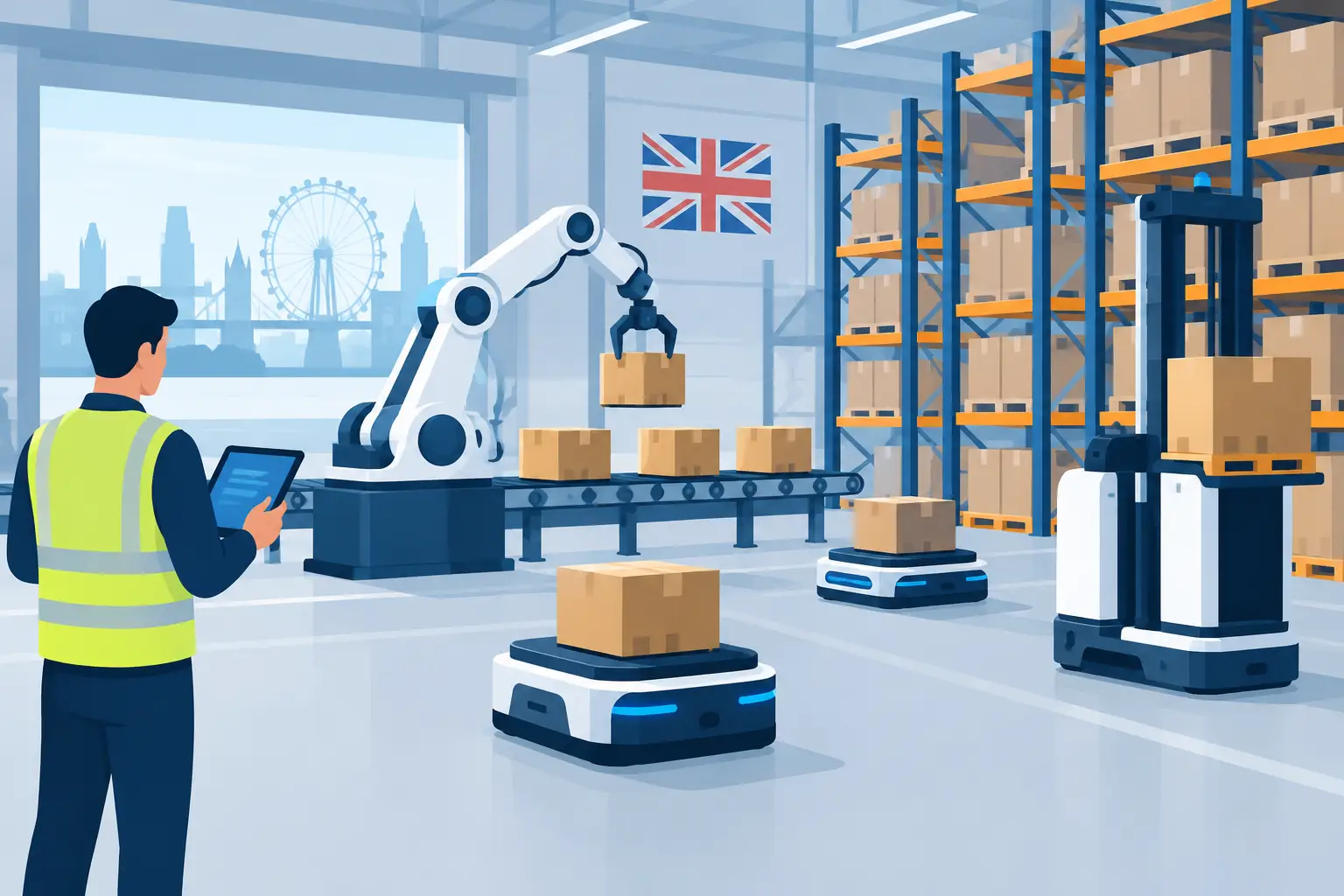
Autonomous mobile robots, often known as AMRs, are increasingly being used to move stock between receiving, storage, picking and packing areas. Unlike fixed conveyor systems, they can work around existing layouts and may be expanded as volumes grow. This makes them particularly relevant for operations that need flexibility rather than a permanent redesign of the building.
Their main value is reducing non-productive walking. In many manual warehouses, pickers spend a significant part of each shift travelling between locations. Mobile robots can bring shelves, totes or pallets closer to the operator, allowing people to focus on picking, checking and exception handling.
However, robots are not a replacement for process discipline. They require clear routes, reliable stock data and safe interaction rules for colleagues and visitors. A poorly organised warehouse will not become efficient simply because robots have been added to it.
Vision technology is improving accuracy at key handovers
Cameras, sensors and machine vision are moving beyond security and into daily operational control. They can verify barcodes, identify damaged packaging, check labels and confirm whether items have been placed in the correct lane. At despatch, vision systems can provide an additional check before consignments leave the warehouse.
This is valuable where mis-picks, incorrect labels or short shipments create costly customer service issues. The benefit is not just fewer errors. It is faster investigation when an exception is raised, because teams have clearer evidence of what happened at each stage.
Vision technology is most effective when it supports existing quality checks rather than duplicating them. Operations leaders should define the specific decision the technology needs to make: confirm an item, flag a problem or create a traceable record. Without that clarity, data quickly becomes noise.
Warehouse systems are becoming the operational control tower
The warehouse management system is increasingly central to automation decisions. A capable WMS can direct put-away, prioritise orders, trigger replenishment and allocate work according to carrier collections, labour availability and customer cut-off times. It connects the physical movement of goods with the commercial commitments behind every order.
The next step is better orchestration between systems. Warehouse, transport and order management data should work together so teams can see the impact of a late inbound delivery, a stock discrepancy or a change to a carrier collection. This matters especially for businesses using multiple sales channels or delivery partners.
Real-time visibility must still be practical. A dashboard with dozens of measures may look comprehensive, but managers need a small number of reliable indicators they can act on: order backlog, pick accuracy, stock availability, despatch performance and dwell time. The best data helps people make quicker, better decisions on the warehouse floor.
Goods-to-person picking is expanding beyond large sites
Goods-to-person systems bring products to fixed picking stations rather than sending workers across the warehouse. They may use automated storage and retrieval equipment, shuttle systems, vertical lifts or mobile shelving. These systems are especially suited to high-order-volume operations with a large number of small items.
The gains can be significant in compact, fast-moving fulfilment environments. Travel time falls, picking becomes more structured and stations can be designed for better ergonomics. It may also be easier to train new colleagues on a controlled picking process than on a large manual pick face.
The trade-off is that fixed systems can require more capital, specialist maintenance and careful capacity planning. A business with highly seasonal demand may prefer modular equipment or a blended model that combines automated picking with flexible manual capacity.
Predictive maintenance is protecting uptime
Automation only delivers value while it is available. Sensors and equipment data are helping warehouse teams identify signs of wear before a conveyor, sorter or automated storage system fails. Monitoring motor temperature, vibration, cycle counts and fault patterns enables maintenance to be scheduled before a disruption affects customer orders.
For operations with tight carrier collection windows, planned maintenance is far less costly than an unexpected stoppage. It also supports safer working conditions by addressing equipment issues early. The key is assigning ownership for alerts and having clear procedures for responding to them. Data without action does not prevent downtime.
Energy efficiency is becoming an automation decision
Sustainability is influencing warehouse design as well as transport planning. Automated lighting, energy monitoring, intelligent charging and more efficient storage layouts can reduce unnecessary consumption. Better slotting can also shorten travel distances for people and equipment, cutting energy use while improving productivity.
Businesses should assess environmental benefits alongside operational ones. For example, high-density storage may reduce the need for additional space, but it must still allow safe access and support the required service speed. The most credible sustainability improvements are measured, practical and tied to daily operations.
What to automate first
The most sensible first step is usually a process with high repetition, measurable cost and a known service risk. This might be label application, parcel dimensioning, stock scanning, replenishment alerts or movement of goods from pick face to packing bench. These are areas where improvements can be tracked against a clear baseline.
Before selecting technology, map the current process from inbound receipt through to despatch. Include rework, waiting time, manual checks and exceptions, not just the intended route. This often reveals that the biggest constraint is poor inventory accuracy or an inefficient layout rather than a lack of automation.
Set success measures before implementation. Depending on the operation, these could include lines picked per hour, order accuracy, stock variance, labour cost per order, despatch cut-off performance and customer claims. Measures should reflect the service that the business is trying to protect, not simply how quickly machinery operates.
A pilot can be useful where the order profile is uncertain or demand changes rapidly. Test technology in one zone, one product category or one shift, then assess the impact on colleagues, customers and supporting processes. This approach reduces risk and gives teams time to adapt.
Avoiding common automation mistakes
The most expensive mistake is automating a process that should first be simplified. If stock locations are inaccurate, product data is inconsistent or workflows change every week, technology may make problems happen faster. Standardise the process, establish reliable data and then decide where automation adds value.
It is also risky to focus only on the warehouse. An automated picking system can create bottlenecks at packing, despatch or carrier handover if those stages are not planned together. Automation should support the complete flow of goods, including transport capacity and final-mile delivery commitments.
Colleague engagement matters too. Teams who understand how new equipment changes their work are more likely to use it safely and identify practical improvements. Training should cover exceptions and recovery procedures, not only normal operation. In a busy warehouse, the ability to recover quickly is as important as the planned workflow.
Building a warehouse automation roadmap
A realistic roadmap balances immediate improvements with longer-term capacity plans. Start by understanding demand patterns, operational constraints and customer promises. From there, prioritise changes that improve visibility and control, then consider equipment that removes repeatable handling or travel.
For businesses outsourcing part or all of their fulfilment, the same principles apply. Ask how stock accuracy is maintained, how performance is measured, what contingency plans exist and whether the operation can scale during peaks. A logistics partner should be able to align warehouse activity with transport, carrier management and delivery requirements, rather than treating each stage in isolation.
NR Logistics works with businesses that need dependable warehousing, fulfilment and distribution support as operational demands change. The best automation decisions are those that strengthen that dependability: helping goods move accurately, teams respond quickly and customers receive the service they were promised.
The next useful action is not to buy the newest technology. It is to walk the warehouse at peak time, follow one order from receipt to despatch, and identify the point where a better process would make the greatest difference.