Regional Versus National Distribution: Which Fits?

A delivery promise can be won or lost long before a parcel reaches the customer. The decision between regional versus national distribution shapes lead times, transport costs, stock availability and the level of control a business retains as order volumes change. For UK businesses, the right model is rarely about choosing the biggest network. It is about matching coverage to demand, service commitments and operational capacity.
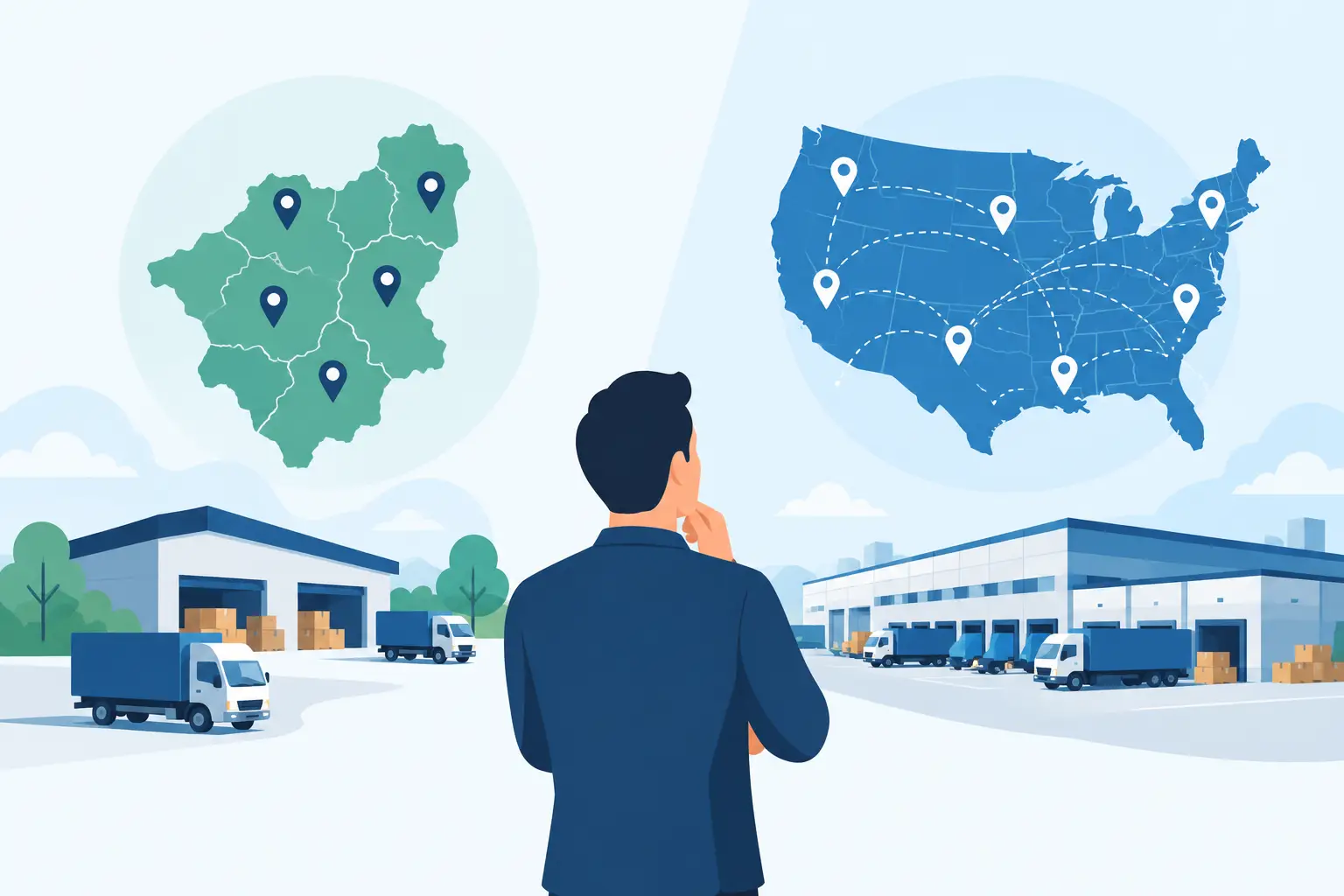
Regional distribution can create speed and local knowledge where demand is concentrated. National distribution provides reach, consistency and a clearer route to scale. Both can work exceptionally well, but each introduces different costs, risks and management requirements.
Regional versus national distribution: the core difference
Regional distribution moves goods within a defined geographical area, such as the Midlands, Greater London, the North West or a group of neighbouring counties. Inventory may be held in a local warehouse or dispatched from a central facility into a dedicated regional transport operation. The model is designed to keep delivery distances short and service responsive.
National distribution is built to serve customers across the UK through one coordinated transport and warehousing network. It may involve a central distribution centre, several strategically located depots, trunking between sites and local last-mile delivery partners. Its purpose is consistent nationwide coverage rather than a narrow local advantage.
The distinction matters because a business can have national ambitions without needing a national distribution operation from day one. Equally, a regional business with tight delivery windows may need a broader network sooner than expected. The most effective approach starts with actual demand patterns, not assumptions about where the business expects to be in several years.
When regional distribution delivers the stronger result
Regional distribution is often the practical choice when the majority of customers sit within a manageable radius of a warehouse or operating base. Shorter routes can support later order cut-offs, dependable same-day options and faster response when a delivery issue needs resolving.
For an e-commerce retailer, this may mean holding fast-moving stock close to its largest customer base. For a manufacturer, it may mean scheduling regular deliveries to retailers, sites or trade customers within a defined territory. Fewer miles per consignment can reduce fuel use, driver hours and exposure to delays on long trunk routes.
Local knowledge also has value. Drivers and planners familiar with delivery restrictions, congestion patterns, site booking rules and difficult access points can make a measurable difference to first-time delivery performance. This is particularly useful for businesses delivering to city centres, construction sites, healthcare locations or trade counters with narrow receiving windows.
However, regional operations have limits. If demand becomes dispersed, businesses can end up paying for long-distance deliveries from a local base. Service levels may become inconsistent outside the core area, while stock held in one region can be unavailable to customers elsewhere. A regional model is efficient when density exists. Without density, its cost advantage can disappear quickly.
Why businesses choose national distribution
National distribution gives customers a consistent delivery proposition wherever they are based in the UK. It is suited to businesses serving multiple regions, supplying national retail accounts, managing wholesale orders or operating an online store with a broad customer footprint.
A well-managed national network allows transport capacity, warehouse space and delivery performance to be planned across the full operation. Rather than building separate arrangements in each area, a business can work to one set of service standards, reporting processes and escalation routes. This improves visibility for operations teams and makes performance easier to measure.
National coverage also protects growth. A business does not need to turn away orders simply because they fall outside a local delivery area. It can introduce new products, win larger accounts and expand sales activity with confidence that the logistics operation can follow.
The trade-off is complexity. Longer delivery lanes require careful route planning, reliable handovers and clear communication between warehousing, transport and customer service teams. National distribution may also require more safety stock if inventory is held centrally and delivery lead times vary by region. The model works best when there is sufficient order volume to justify the infrastructure and coordination behind it.
Cost is more than the price per delivery
It is tempting to compare regional and national distribution using a simple rate per pallet, parcel or consignment. That figure matters, but it does not tell the full story. The lower-cost option on paper can create higher costs through late deliveries, split shipments, stock transfers, failed delivery attempts or customer churn.
Regional networks can lower mileage and allow more efficient multi-drop routes in high-density areas. They may also reduce the need for premium transport services when customers are close to the stockholding location. Yet a single regional warehouse can become expensive when orders must travel hundreds of miles to reach outlying customers.
National distribution can benefit from scale, consolidated linehaul movements and shared capacity across the network. But businesses should account for trunking, cross-docking, depot handling and the administration required to manage multiple carriers or delivery partners. Cost control comes from understanding the total landed cost of fulfilment, not choosing the lowest individual transport rate.
A useful assessment should include delivery distance, average order value, order frequency, product size, returns volumes, failed-delivery risk and the cost of holding stock at each location. It should also consider the financial impact of missing a customer promise. For a time-sensitive B2B delivery, one late consignment can disrupt a production line or damage a long-standing account.
Service levels should lead the decision
The right distribution model begins with the service customers genuinely require. Next-day delivery across the UK, scheduled delivery to business premises and same-day delivery within selected regions are different services with different operational demands.
If customers need rapid delivery in one metropolitan area, regional fulfilment with dedicated local transport may be the best fit. If customers expect a uniform next-day offer across England, Scotland and Wales, national distribution is likely to provide greater consistency. Where both requirements exist, a blended model may be more effective than forcing every order through one network.
For example, a retailer might hold core stock centrally for nationwide orders while placing high-volume lines in a regional facility close to its busiest market. A supplier may use scheduled national distribution for routine replenishment but retain same-day capacity for urgent local requirements. This approach can improve speed without duplicating every product in every location.
Inventory strategy changes the equation
Distribution and inventory cannot be planned separately. A regional network usually needs stock positioned closer to customers, which can improve availability and shorten fulfilment times. It can also increase working capital, warehouse handling and the risk of stock sitting in the wrong place.
A centralised national model keeps inventory in fewer locations, making stock control simpler and reducing the total safety stock required for some product ranges. The downside is that every delivery depends on transport covering a longer distance. If a vehicle delay, capacity shortage or disruption occurs, the customer may have fewer alternatives.
The right balance depends on product velocity and criticality. Fast-moving, high-margin or urgent items may justify regional stockholding. Slow-moving or specialist goods are often better held centrally. Accurate inventory data, sensible reorder points and clear stock-allocation rules are essential whichever option is chosen.
Sustainability needs to be measured, not assumed
Shorter regional routes can reduce emissions per delivery, particularly where delivery density is strong and electric vehicles are suitable for the route. Local operations can also reduce unnecessary road miles and support more efficient same-day or multi-drop planning.
National distribution can still support lower-emission operations when loads are consolidated, trunk routes are well planned and vehicle capacity is used effectively. Sending multiple partially loaded vehicles between regions is unlikely to be efficient, regardless of the network design.
Businesses should assess emissions alongside service and cost. The practical questions are how full vehicles run, how many miles are driven per successful delivery, where charging infrastructure is available and whether delivery windows permit efficient route planning. A credible sustainability plan improves when it is tied to real operational data.
Build for the business you operate now and the one you are growing
The decision does not have to be permanent. Distribution networks should be reviewed as customer locations, sales channels and product ranges change. A model that worked for 200 weekly orders may not work for 2,000, especially when those orders move from one region into a national customer base.
Start by mapping where orders originate, where they are delivered, how quickly they must arrive and what each service failure costs. Then test whether regional, national or hybrid distribution gives the best balance of reliability, control and scalable capacity. NR Logistics supports businesses with transport, warehousing and coordinated supply chain management designed around those operational realities.
The strongest distribution strategy is the one that makes the customer promise achievable every day, while leaving the business room to grow without losing control of cost or service.