Logistics Sustainability Trends Shaping UK Delivery

A late delivery, an empty return journey and an overheated warehouse can all increase carbon output, operating cost and customer risk at the same time. That is why logistics sustainability trends are now a practical board-level issue for UK businesses, not simply a reporting exercise. The strongest approaches protect delivery performance while making every mile, pallet position and resource work harder.
For retailers, courier operators and growing e-commerce businesses, the priority is clear: reduce avoidable emissions without creating slower lead times, weaker capacity or higher fulfilment complexity. Sustainable logistics must be built into day-to-day operations, where it can improve reliability as well as environmental performance.
The logistics sustainability trends changing UK supply chains
The market is moving beyond broad carbon commitments towards measurable operational change. Businesses are assessing how goods enter their network, where inventory sits, how orders are packed and how vehicles complete each route. The result is a more connected view of sustainability, cost control and service quality.
Electric vehicles are becoming a targeted delivery tool
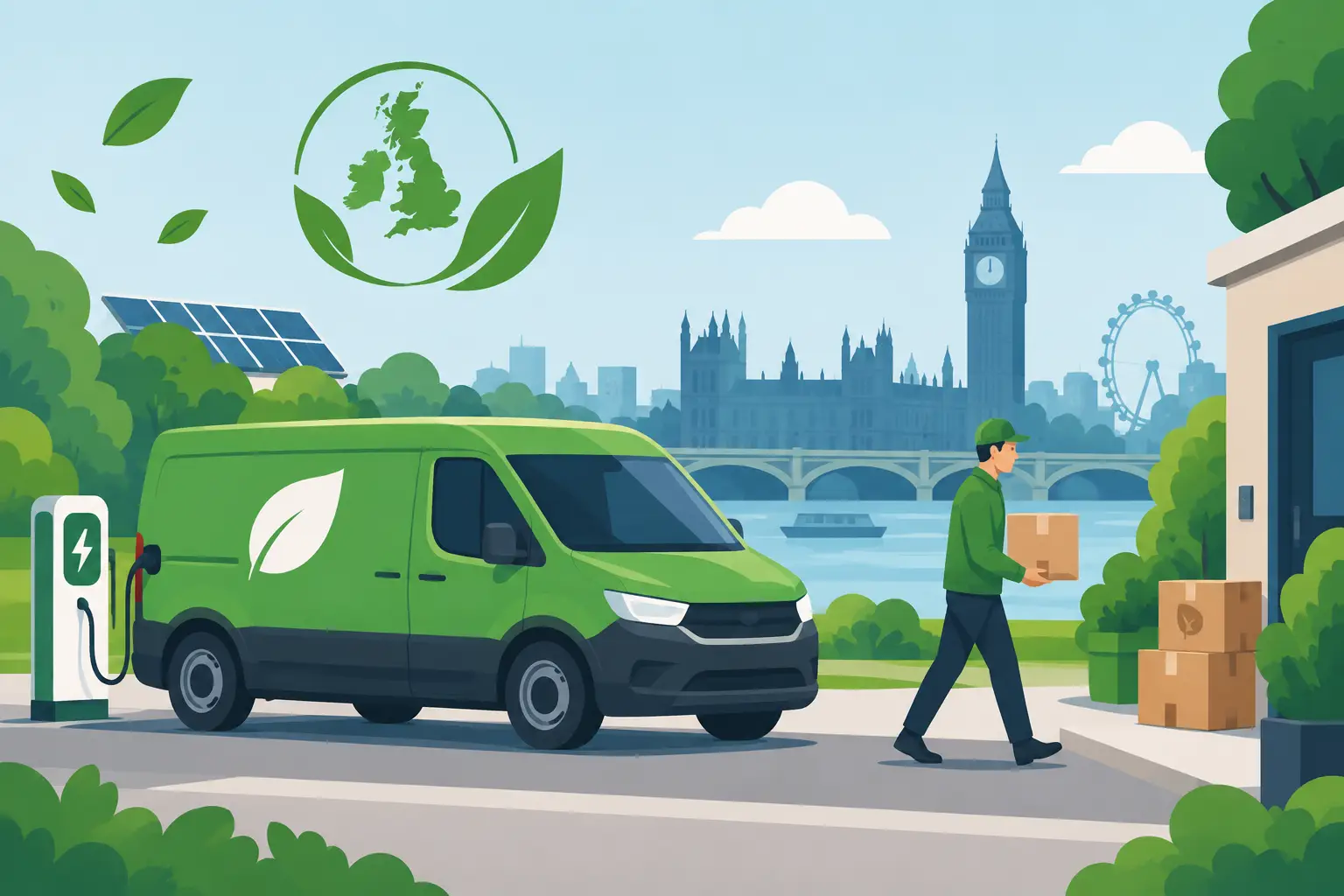
Electric vans are one of the most visible developments in urban logistics. They are especially suited to predictable routes, city-centre work and last-mile delivery schedules where vehicles can return to base for charging. For businesses operating in low-emission zones or serving environmentally conscious customers, electric transport can lower tailpipe emissions while supporting a modern delivery proposition.
The trade-off is operational planning. Vehicle range, payload, charging time, depot power capacity and route geography all matter. An electric vehicle is not automatically the right answer for every long-distance or variable-load journey. The most effective fleets match vehicle type to route profile, then use live planning data to avoid wasted mileage and charging disruption.
A mixed fleet will remain practical for many UK supply chains in the near term. What matters is using each vehicle where it delivers the best operational and environmental result, rather than applying one transport model to every job.
Route optimisation is reducing emissions before a vehicle moves
The cleanest mile is often the one that is not driven. Better route planning reduces distance travelled, idling time, failed delivery attempts and empty running. It also helps transport managers respond quickly when traffic, late collections or changing customer requirements threaten delivery performance.
For a business shipping high volumes, small improvements quickly add up. Combining nearby consignments, selecting suitable delivery windows and planning backloads can reduce fuel use without reducing service coverage. Reliable route data also gives businesses a firmer basis for measuring emissions per delivery, per mile or per consignment.
This is where sustainability supports commercial resilience. Efficient routes can protect margins during periods of rising fuel costs, driver shortages and network pressure.
Warehousing is moving towards lower-energy operations
Warehouse sustainability is no longer limited to switching off lights at the end of the shift. Modern operators are reviewing lighting, heating, battery charging, equipment use, packaging flows and stock placement to reduce the energy required for every order handled.
LED lighting, motion controls and energy monitoring are practical starting points, but layout and process design matter just as much. Fast-moving stock placed close to packing and despatch areas reduces travel within the building. Accurate inventory management limits obsolete stock, unnecessary handling and urgent replacement movements. Well-organised storage also improves picking accuracy, which prevents avoidable returns.
The right investment depends on the site. A high-throughput fulfilment operation may benefit most from process redesign and automation, while a smaller storage facility may achieve faster gains through energy controls, better stock visibility and reusable handling equipment.
Packaging is being treated as a logistics decision
Packaging has a direct impact on vehicle utilisation, warehouse space, damage rates and returns. Oversized boxes create wasted air in vehicles and increase material use. Under-protected products can lead to damage, re-delivery and dissatisfied customers. Sustainable packaging is therefore not simply about choosing recyclable material. It is about using the right amount of protection for the product and the journey.
Businesses are increasingly reviewing carton sizes, void fill, labelling and returnable transit packaging. A well-designed packing process can reduce waste while improving throughput at the packing bench. It can also make collection and recycling easier for the recipient.
There is no universal packaging solution. Fragile, temperature-sensitive and high-value goods need different protection levels. The commercial objective is to reduce unnecessary material without transferring cost or risk elsewhere in the supply chain.
Why visibility matters in sustainable logistics
Sustainability claims are only useful when they are supported by dependable information. Businesses need visibility across transport, warehousing and fulfilment to understand where emissions and inefficiencies are occurring. That means tracking delivery activity, vehicle utilisation, energy use, stock movements, returns and carrier performance in a consistent way.
Clear reporting helps operations teams identify practical changes. If one route has a high rate of failed delivery attempts, the solution may be better customer communication or revised delivery windows. If one product line creates excessive returns, the issue may sit in product information, packaging or picking accuracy rather than transport. Data prevents sustainability activity from becoming guesswork.
It also supports better supplier conversations. Larger customers increasingly expect evidence of emissions reduction from their logistics partners, while procurement teams need information they can use in tender processes, internal reporting and customer communications. Reliable figures are more valuable than ambitious statements that cannot be measured.
Returns and reverse logistics are becoming more important
The growth of e-commerce has made returns a major sustainability challenge. Every return can involve collection, transport, checking, repacking, restocking, resale, recycling or disposal. When the process is poorly managed, costs rise and usable stock may lose value unnecessarily.
A strong reverse-logistics process starts with prevention. Accurate product descriptions, quality control and reliable order fulfilment reduce returns before they enter the network. When returns are unavoidable, businesses need fast decisions about whether goods should be restocked, repaired, consolidated, redirected or responsibly recycled.
Consolidating returns and routing them to the correct location can reduce unnecessary movements. The priority is to retain product value wherever possible while keeping the customer experience straightforward. A difficult returns process may reduce transport activity in the short term, but it can damage retention and create more customer service pressure. Sustainable operations still need to be commercially sensible.
How businesses can act on sustainability without disrupting service
The most successful programmes begin with a practical baseline. Before setting targets, assess current vehicle mileage, load fill, fuel or energy use, warehouse consumption, packaging volumes, returns and delivery success rates. This shows where the most meaningful opportunities sit.
From there, focus on changes that improve both efficiency and environmental performance. Route optimisation, carrier consolidation, improved inventory accuracy and better packaging design can often produce measurable results without major capital expenditure. Electric vehicles, charging infrastructure and warehouse upgrades may follow where the operating case is proven.
It is also essential to involve the people running the operation. Drivers understand route constraints. Warehouse teams see where handling time and materials are wasted. Customer service teams know why deliveries fail or orders return. Sustainable change is more likely to last when it is designed around real working conditions rather than imposed as a separate initiative.
Building a more resilient logistics model
The direction of travel is clear: lower-emission logistics will increasingly be expected by customers, procurement teams and regulators. Yet the best response is not to chase every new technology or make promises that cannot be maintained during peak periods. It is to build a supply chain that uses resources more intelligently while keeping goods moving safely and on time.
For UK businesses, that means choosing partners with the transport capability, warehousing control and operational visibility to make change workable at scale. NR Logistics supports this approach through dependable distribution, flexible warehousing and electric fleet options designed around real delivery requirements. The next step is to identify the part of your operation where smarter logistics can deliver the quickest, most credible improvement.