Own Fleet vs Transport Subcontractors: Which Fits?

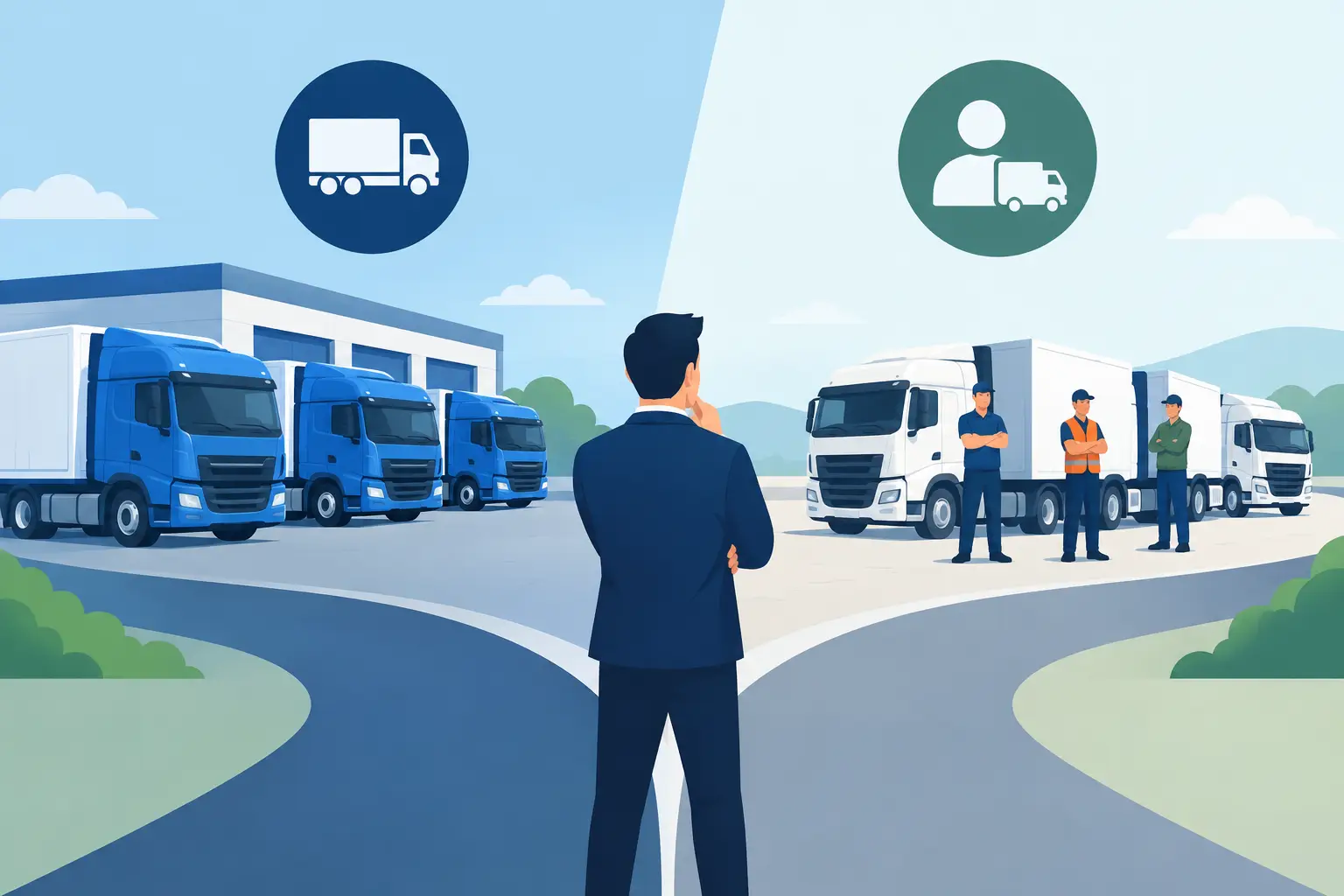
A missed collection window, an unexpected volume spike or a vehicle off the road can quickly expose weaknesses in a delivery operation. The decision between own fleet vs transport subcontractors is therefore about more than the cost of moving a parcel or pallet. It affects customer experience, operational control, capacity planning and the ability to keep promises when demand changes.
For UK businesses managing e-commerce fulfilment, courier capacity or time-critical distribution, there is no universal right answer. An owned fleet can provide direct control and a visible service standard. Subcontracted transport can add reach, flexibility and specialist capability without the fixed commitment of operating vehicles. The strongest model depends on the shape of your volumes, delivery geography, service requirements and appetite for operational responsibility.
What the fleet decision really changes
Transport is often assessed through a simple per-delivery or per-mile rate. That figure matters, but it rarely captures the full commercial picture. A fleet decision changes where risk sits, how quickly capacity can be increased, who manages compliance and how much visibility your team has over daily execution.
With an owned fleet, the business carries responsibility for vehicles, drivers, maintenance, insurance, route planning and regulatory compliance. In return, it gains direct influence over how deliveries are handled. With subcontractors, much of that responsibility moves to the provider, but service quality relies on strong supplier selection, clear operating standards and active performance management.
The question is not whether one approach is inherently better. It is whether the model supports a dependable operation at the required cost and scale.
Own fleet vs transport subcontractors: the practical trade-offs
Where an owned fleet delivers value
An owned fleet is often compelling when delivery volumes are consistent, routes are predictable and service performance is central to the customer proposition. Regular trunking between fixed sites, dense multi-drop routes and dedicated customer contracts can create the utilisation needed to justify vehicle ownership or long-term lease arrangements.
Control is the principal advantage. Your team can set vehicle presentation standards, driver training, delivery procedures and escalation processes. This is particularly valuable where drivers represent your brand at the doorstep, goods require specialist handling or customers expect narrow delivery windows. Direct management can also make it easier to integrate drivers with warehouse teams, optimise loading patterns and refine routes using live operational data.
A fleet can create a more stable cost base once utilisation is high enough. Rather than paying a variable margin to an external provider for every movement, you can spread fixed costs across regular work. Businesses with clear demand patterns may also find it easier to invest in lower-emission vehicles, including electric vans, where routes, charging access and daily mileage are suitable.
The trade-off is commitment. Vehicles still cost money when demand falls. Drivers need holiday cover, training and management. A breakdown, sickness absence or seasonal peak requires contingency capacity. Owning the asset does not remove risk – it brings that risk into your operation.
Where subcontracted transport is stronger
Transport subcontractors are often the more efficient choice when volumes fluctuate, delivery destinations vary widely or the operation needs capabilities that would be expensive to build internally. A growing online retailer may need ten vans one week and thirty during a promotion. A courier operator may need rapid regional cover after winning a new contract. In these situations, flexible external capacity protects service without requiring a major capital commitment.
Subcontracting can also provide access to specialist vehicles, trained crews and established networks. Temperature-controlled distribution, oversized loads, same-day work and difficult-to-reach locations each carry their own operational requirements. A suitable partner can supply the right resource without forcing the client to recruit, equip and manage an additional in-house division.
Variable pricing is not automatically more expensive. It can be financially sensible when it prevents empty mileage, underused vehicles and fixed overheads during quieter periods. The key is to compare the full cost of each option, rather than treating a subcontractor’s day rate as directly comparable with a driver’s wage.
The compromise is less direct control. Even an excellent subcontractor works within its own fleet, driver pool and operating pressures. Service levels must be defined clearly, data must be shared promptly, and exceptions need a reliable route for escalation. Without these controls, a flexible capacity solution can become difficult to manage.
Compare total cost, not just the transport rate
A sound decision starts with a realistic total-cost model. For an owned fleet, include vehicle finance or depreciation, insurance, fuel or electricity, maintenance, tyres, telematics, licensing, driver wages, employer costs, recruitment, training, parking, administration and standby capacity. Do not overlook the management time required to plan work, monitor compliance and resolve daily issues.
For subcontracted transport, examine the quoted rate alongside minimum charges, waiting time, fuel surcharges, redelivery costs, peak-period premiums and any charges for specialist requirements. Consider how quickly rates may change when capacity tightens. A low headline price is less valuable if the provider cannot cover work when your customer needs it most.
The most useful comparison is based on cost per successful delivery, collection or route, measured across a representative period. This should include failed deliveries, empty running, claims, late arrivals and customer service impact. A model that appears cheaper on paper can become expensive if it creates missed service commitments or repeated manual intervention.
Match the model to volume and geography
Route density is one of the clearest indicators. An owned fleet becomes more attractive when vehicles can leave full, make efficient drops within a defined area and return with useful backloads or collections. The same is true for regular inter-site movements with fixed timetables.
Subcontracting usually performs better where demand is uneven. National coverage, remote destinations, short-notice jobs and one-way movements can all create inefficient utilisation for a fleet that must be kept available every day. External providers can pool demand across multiple customers, which may make otherwise difficult work commercially viable.
Seasonality deserves particular attention. If your business experiences sharp peaks around product launches, retail events or Christmas, calculate capacity for both average and maximum demand. Building an owned fleet for peak volume can leave expensive assets idle for much of the year. Building only for average volume can put customer commitments at risk during the periods that matter most.
Service control, risk and sustainability
The right model must protect delivery quality, not simply provide vehicles. Set measurable expectations for on-time performance, proof of delivery, vehicle condition, claims handling, driver conduct, tracking updates and response times when something goes wrong. These standards apply whether drivers are employed directly or supplied by a partner.
For subcontracted work, due diligence should cover operator licences, insurance, maintenance processes, driver checks, health and safety practices, data handling and financial stability. A dependable provider will be able to evidence these controls and explain how it manages disruption. It should also be willing to share meaningful performance data rather than relying on broad assurances.
Sustainability may influence the balance too. Businesses with predictable urban routes can make a strong case for electric vehicle deployment, particularly where charging is available at a depot or warehouse. For broader national coverage, a subcontracted network may provide access to lower-emission options in the locations where they are practical. The objective is credible emissions reduction without weakening service reliability.
A hybrid model often protects growth
Many successful operations do not choose one model exclusively. They retain an owned fleet for core, high-volume or brand-sensitive routes, then use approved subcontractors for peak demand, regional expansion, specialist services and contingency cover. This creates a stable operational centre while avoiding the cost of maintaining surplus assets for every possible scenario.
A hybrid structure only works when responsibilities are clear. The planning team needs a defined rule set for allocating work, shared visibility across internal and external capacity, and consistent customer communication. The subcontractor should feel like an extension of the operation, but performance still needs to be managed against agreed standards.
NR Logistics supports this type of approach by combining transport capacity, warehousing and broader supply chain coordination, helping businesses align stock flow, fulfilment and delivery requirements rather than treating each movement in isolation.
Make the decision with live operational evidence
Before committing, review at least several months of data covering volumes, postcodes, route lengths, vehicle fill, failed deliveries, seasonal variation and service failures. Test the assumptions behind both options, including what happens when a major customer increases demand, a depot faces disruption or a vehicle is unavailable at short notice.
The best transport model is the one that gives your customers confidence while keeping your operation commercially disciplined. Start with the routes and volumes you must protect every day, then build flexible capacity around the work that changes. That approach keeps delivery performance dependable now and gives the business room to move when growth arrives.