
Inventory Management vs Warehouse Management

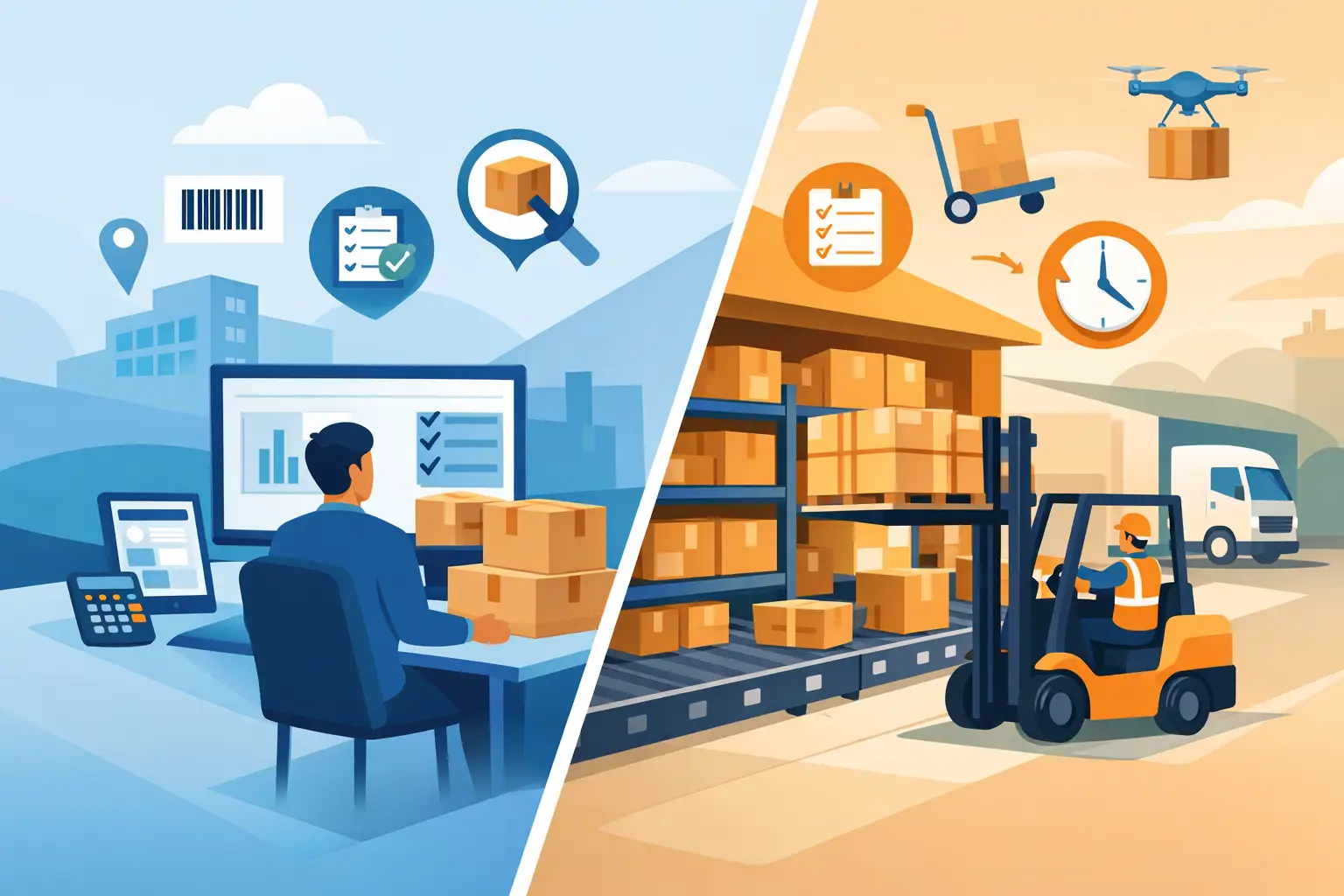
A stock discrepancy rarely starts on the shelf. It usually starts much earlier – in the way a business tracks inventory, controls movement, or structures warehouse operations. That is why the distinction between inventory management vs warehouse management matters so much. They are closely connected, but they are not interchangeable, and treating them as the same thing often leads to avoidable cost, fulfilment delays, and poor visibility.
For operations leaders, e-commerce brands, courier networks, and growing businesses, the difference is practical rather than academic. One discipline focuses on what stock you have, where it should be, and when it needs replenishing. The other focuses on how goods are physically handled, stored, picked, packed, and dispatched inside a warehouse. When both work together, service levels improve. When one is weak, the whole supply chain feels it.
Inventory management vs warehouse management: the core difference
Inventory management is the control of stock across its lifecycle. It covers ordering, stock level planning, replenishment, forecasting, stock accuracy, and the financial efficiency of holding goods. Its main question is simple: do you have the right amount of stock in the right place at the right time?
Warehouse management is the control of warehouse operations. It covers goods-in, putaway, storage layout, location tracking, picking, packing, dispatch, labour flow, and how space and processes are used. Its main question is different: how do you move and handle goods efficiently within the warehouse?
That difference matters because a business can have strong warehouse operations and still hold the wrong stock. It can also forecast inventory well and still struggle with slow picking, poor slotting, or dispatch bottlenecks. One governs stock decisions. The Other governs warehouse execution.
What inventory management is responsible for
Inventory management sits closer to planning and control. It determines reorder points, safety stock, stock turn, SKU performance, and demand alignment. For a business selling online, it helps avoid overselling fast-moving lines and overbuying slow-moving ones. For a courier or fulfilment operator, it protects service continuity by making sure products and packaging materials are available when needed.
The commercial impact is significant. Too much stock ties up working capital and storage space. Too little stock creates missed sales, delayed orders, and frustrated customers. Good inventory management reduces both risks by giving businesses a clearer view of demand patterns and stock health.
It also supports better decision-making across purchasing, promotions, and expansion. If inventory data is accurate, a business can plan with more confidence. If it is unreliable, every other decision becomes harder.
Key inventory management priorities
Inventory management typically focuses on stock accuracy, replenishment timing, demand forecasting, batch and expiry control where relevant, and visibility across channels or locations. In multi-channel retail or outsourced fulfilment, that visibility becomes even more important. A product that appears available on paper but cannot actually be picked is not available in any meaningful sense.
This is why inventory management often extends beyond the warehouse itself. It influences procurement, sales planning, returns handling, and customer promise dates.
What warehouse management is responsible for
Warehouse management is more operational and process-driven. It concerns the physical flow of goods from arrival to dispatch. That includes booking in deliveries, checking quantities, assigning storage locations, managing bin accuracy, directing picks, packing orders correctly, and preparing consignments for onward transport.
A well-run warehouse improves speed, accuracy, and cost control. It reduces wasted movement, makes better use of storage space, and helps teams process more orders without sacrificing quality. For businesses with peak trading periods or time-sensitive distribution needs, warehouse management is often the difference between stable performance and daily firefighting.
Where inventory management asks how much stock should be held, warehouse management asks how that stock should be handled once it is on site.
Key warehouse management priorities
Warehouse management usually focuses on layout efficiency, picking productivity, order accuracy, labour utilisation, goods traceability, and dispatch performance. In many operations, it also includes health and safety, damage reduction, and process consistency across shifts.
These details are easy to underestimate until volume increases. A warehouse that functions adequately at low order volumes can become inefficient very quickly when SKUs expand, order profiles become more complex, or next-day cut-off times get tighter.
Where the two functions overlap
Although inventory management and warehouse management are distinct, they depend on each other. Inventory records rely on warehouse accuracy. Warehouse efficiency relies on correct inventory data. If stock is placed in the wrong location, counted incorrectly, or picked without proper system updates, inventory visibility drops. If inventory rules are poor, warehouse teams may be dealing with excess stock, stockouts, or badly timed replenishment requests.
This overlap is why many businesses use integrated systems and outsourced partners that can manage both disciplines together. Separate teams, separate processes, or disconnected software can still work, but only if communication is disciplined and data is updated in real time.
In practice, the strongest operations do not debate which function matters more. They make sure the two are aligned.
Inventory management vs warehouse management in day-to-day operations
A simple example makes the distinction clearer. Imagine an e-commerce retailer preparing for a seasonal sales spike. Inventory management determines how many units to order, when to bring them in, and what buffer stock is needed. Warehouse management determines where those units will be stored, how they will be picked at speed, and how outbound orders will be processed without congestion.
Another example is a fulfilment operation handling multiple clients. Inventory management tracks stock ownership, availability, reorder status, and item-level movement. Warehouse management ensures each client’s stock is stored correctly, segregated where needed, and dispatched according to agreed service levels.
Both functions affect customer experience, but in different ways. Inventory management protects availability. Warehouse management protects execution.
Which one does your business need most?
For many businesses, the honest answer is both. Still, the pressure point varies depending on the operation.
If your business regularly runs out of popular lines, carries too much dead stock, or struggles to forecast demand, the bigger issue is likely inventory management. If stock is available but orders are late, picks are inaccurate, or warehouse space feels chaotic, warehouse management is more likely the immediate concern.
There is also an issue of scale. Smaller businesses often begin with informal stock control and basic storage processes. That may be workable for a time. As order volume grows, channels multiply, and service expectations tighten, informal systems tend to break down. At that stage, businesses usually need stronger stock discipline, stronger warehouse processes, or both.
Why businesses often confuse the two
The confusion usually comes from the fact that both deal with stock, both rely on accurate data, and both often sit within the same operational conversation. In some businesses, one person or one provider may handle elements of both. That can blur the boundaries.
But combining responsibility is not the same as combining purpose. A warehouse team may perform stock counts, for example, but that does not mean warehouse management covers the full job of forecasting, replenishment planning, and inventory optimisation. Equally, a stock planner may decide what levels to hold, but that does not mean they are solving picking route inefficiencies or dispatch flow.
Clear definitions lead to better accountability. Better accountability usually leads to better performance.
The role of systems and outsourced support
Software can support both areas, but it only works if processes are sound. Inventory tools help track stock levels, forecast demand, and maintain visibility across channels. Warehouse systems help direct storage, picking, packing, and dispatch. When integrated properly, they reduce manual errors and improve control.
Outsourced logistics support can also close gaps quickly, especially for businesses that are scaling faster than their internal operation can handle. A provider with warehousing, inventory control, fulfilment, and transport capability can remove friction between planning and execution. That is particularly useful when service reliability matters as much as cost.
For businesses looking to simplify operations, this is where an experienced partner such as NR Logistics can add value – not just by storing goods, but by supporting the wider flow of stock through the supply chain.
Choosing the right focus for long-term performance
The best way to think about inventory management vs warehouse management is this: inventory management decides what should happen with stock, while warehouse management makes sure the physical operation can deliver it. One without the other creates blind spots.
If your stockholding is efficient but your warehouse process is slow, customer service still suffers. If your warehouse runs neatly but your replenishment planning is poor, capital and availability suffer. Reliable performance comes from joining the two together with clear process ownership, accurate data, and a warehouse operation built to support real demand.
For growing UK businesses, that balance is not a luxury. It is what keeps fulfilment stable, costs under control, and customers confident in every order you send.