Warehouse Consolidation Case Study: UK Results

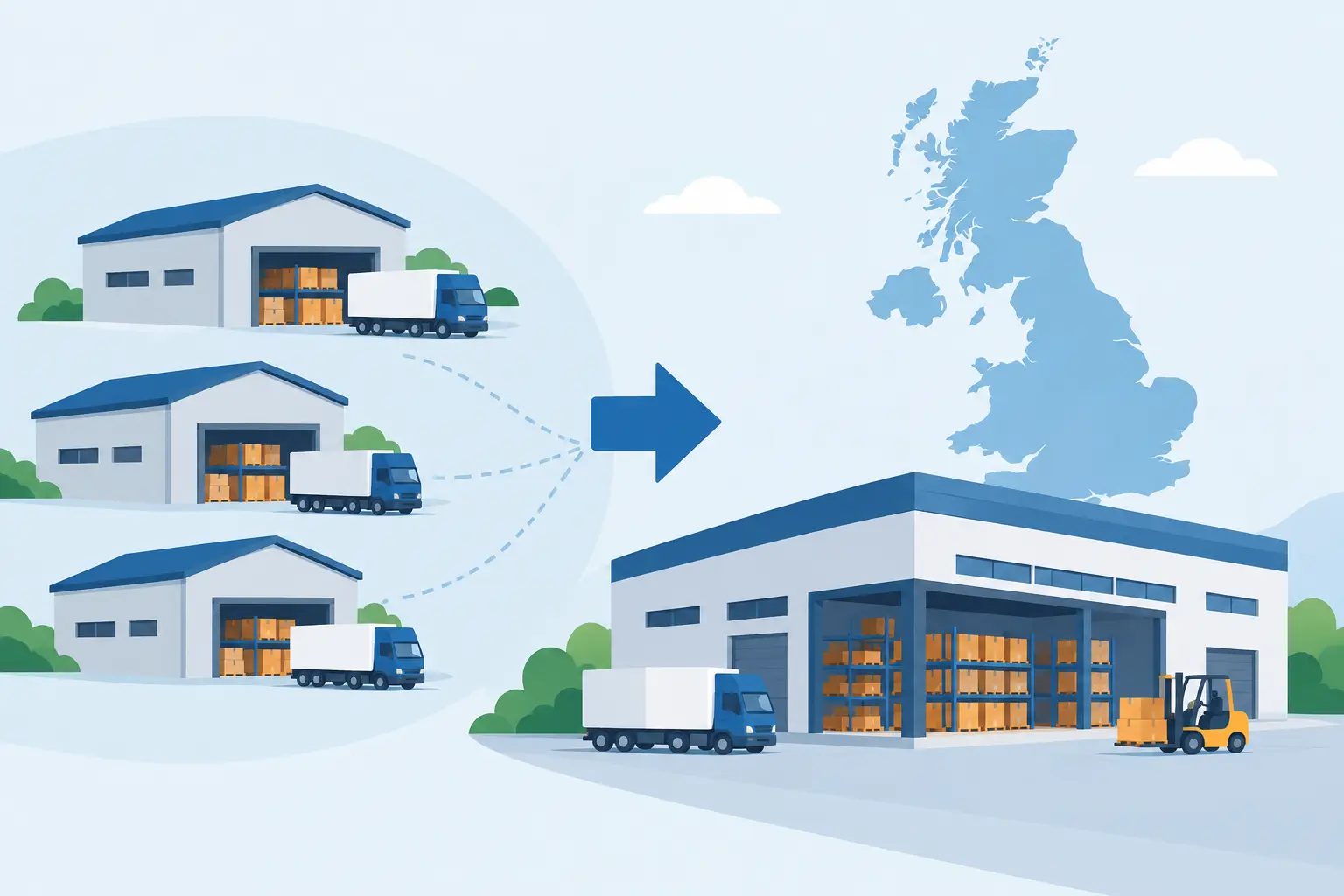
A growing online retailer was paying for three warehouses but could not promise that a customer’s full order would leave from one location. Stock was split by product range, replenishment moves were frequent, and customer service teams were spending too much time locating inventory. This warehouse consolidation case study examines how a more coordinated UK distribution model improved control without compromising delivery speed.
The example is anonymised, but the operational issues are familiar to many e-commerce and B2B businesses. Growth had created a larger logistics footprint than the business needed. The challenge was not simply to reduce buildings. It was to create a network that could hold the right stock, process orders accurately and maintain dependable nationwide delivery.
The starting point: high cost and fragmented stock
The retailer operated three regional warehouses: a primary fulfilment site, an overflow facility and a smaller specialist location. Each had developed for a valid reason. One supported rapid sales growth, another accommodated seasonal stock, and the third handled slower-moving lines that no longer fitted comfortably at the main site.
Over time, the model created duplication. Fast-selling products were held at more than one location to avoid stock-outs. Smaller orders were dispatched from different sites, increasing carrier collections and packaging use. Transfers between warehouses became a regular cost rather than an exception.
The business had visibility of stock at site level, but not enough control over total available inventory. A product could appear unavailable to the online store while units sat in another warehouse. Forecasting was also harder because replenishment teams were planning stock movements between locations as well as supplier inbound deliveries.
The operation faced four linked pressures:
- warehouse occupancy was uneven, with the main site frequently constrained while overflow space remained underused;
- internal stock transfers added handling, transport cost and opportunities for damage or error;
- split consignments increased fulfilment cost and created a less consistent customer experience; and
- managers had limited time to improve performance because teams were dealing with daily exceptions.
Consolidation was considered because the existing network was expensive to operate, but cost reduction was not the only goal. The retailer needed a model that could support peak demand, maintain delivery cut-off times and provide accurate inventory data for commercial decisions.
Warehouse consolidation case study: defining the right model
The first decision was not whether to close warehouses. It was whether one central site could genuinely support the required service level. That required a detailed assessment of order profiles, SKU dimensions, seasonal peaks, supplier lead times, carrier performance and postcodes served.
The retailer found that most orders could be fulfilled from a single, well-located distribution centre. A smaller proportion of specialist and oversized products required dedicated handling, but these could be managed within a defined area of the same facility rather than through a separate warehouse.
This was not a case for putting every item into one building regardless of demand. Some businesses benefit from regional fulfilment sites, particularly where same-day delivery, bulky goods or temperature-controlled products are central to the proposition. In this instance, however, the volume and product mix did not justify three separate stockholding locations.
The proposed model used one primary warehouse with sufficient racking capacity, flexible floor space for peak periods and clear processes for inbound stock, pick-and-pack, returns and carrier handovers. Contingency capacity was retained through an external logistics partner rather than through permanent underused space.
Building the transition plan
A warehouse consolidation project can fail when stock is moved before the operating model is ready. The retailer therefore treated implementation as a controlled transition, not a property exercise.
Inventory was first cleansed and categorised. Obsolete, damaged and slow-moving stock was identified, while fast-moving lines were allocated to accessible pick faces. Product master data was reviewed so dimensions, weights, barcodes and storage requirements were accurate before migration began.
The move was then phased around demand patterns. High-volume products were transferred first, but only once the central site had been tested for receiving, putaway and picking capacity. Stock was moved during lower-demand periods where possible, and the legacy warehouses continued limited fulfilment until inventory accuracy at the new location was confirmed.
Technology discipline was essential. The warehouse management process had to show stock as available only when it had been received, checked and placed in a live location. This avoided the common problem of inventory appearing sellable while still in transit or awaiting quality checks.
Carrier planning was also brought into the project early. Consolidation altered collection volumes, line-haul requirements and later cut-off opportunities. By aligning warehouse operating hours with carrier collections, the retailer could protect next-day delivery performance while reducing the number of separate dispatch points.
What changed in day-to-day operations
Once the central warehouse was fully operational, the retailer changed more than its address. It introduced slotting rules based on sales velocity, with frequently picked products positioned closer to packing stations. Bundled products and items commonly bought together were stored to reduce unnecessary travel during picking.
Inbound deliveries were booked against available dock and labour capacity. This gave the warehouse team more control over when stock arrived and prevented receiving activity from disrupting order fulfilment. Cycle counts were scheduled by stock value and movement, rather than relying solely on a disruptive annual stocktake.
The business also established clearer performance measures. Rather than reporting only total orders dispatched, the team monitored order accuracy, same-day dispatch rate, inventory accuracy, units picked per labour hour, dwell time for inbound stock and the proportion of orders sent as split consignments.
These measures gave managers a practical view of whether consolidation was delivering the intended benefits. A cheaper warehouse is not a successful result if orders are leaving late or stock accuracy is deteriorating.
The operational outcome
Within the first full trading cycle, the retailer reduced its warehouse footprint from three sites to one primary location. Internal transfer movements fell substantially because stock was no longer routinely repositioned between facilities. Fewer split consignments also reduced packaging use and simplified the customer delivery journey.
The biggest gain was inventory control. With stock held in one managed location, the retailer could make purchasing decisions against a more reliable view of available inventory. Teams could identify slow-moving lines earlier, reduce duplicated safety stock and allocate space according to demand.
Labour planning improved as well. Instead of maintaining separate management, receiving and dispatch functions across several sites, the business could schedule resources around one set of daily volumes. This did not mean reducing headcount without care. During the transition, experienced staff were needed to protect accuracy and train teams on the new processes. The long-term benefit came from using labour more productively, not simply from cutting people out of the operation.
Service performance remained stable because the project had protected key delivery requirements from the outset. Centralisation would have been the wrong choice if it had introduced unacceptable transit times for priority customers. The retailer instead used a combination of planned carrier collections and suitable transport services to maintain its delivery promise.
What this case study shows for UK businesses
Warehouse consolidation is most effective when it solves a real operating problem. If stock is fragmented, transfers are frequent and sites lack a clear role, a consolidated model can improve cost control and service visibility. It can also support more consistent fulfilment, particularly for businesses with expanding product ranges and multiple sales channels.
However, consolidation is not automatically the lower-risk option. A single warehouse can create dependency on one location, one workforce and one local transport network. Businesses should plan for disruption, including peak trading pressure, systems outages, carrier delays and facility access issues. A resilient model needs documented contingency arrangements, not just a well-run primary site.
For organisations seeking outsourced support, the right logistics partner can provide the capacity, warehouse discipline and transport coordination needed to make consolidation workable. NR Logistics supports businesses that need reliable warehousing, fulfilment and nationwide distribution from a coordinated operational base.
The most useful question is not, “How many warehouses should we have?” It is, “What network gives customers the service they expect while giving the business control over stock, cost and growth?” The answer should be built from data, tested in real operating conditions and designed to keep working when demand changes.